
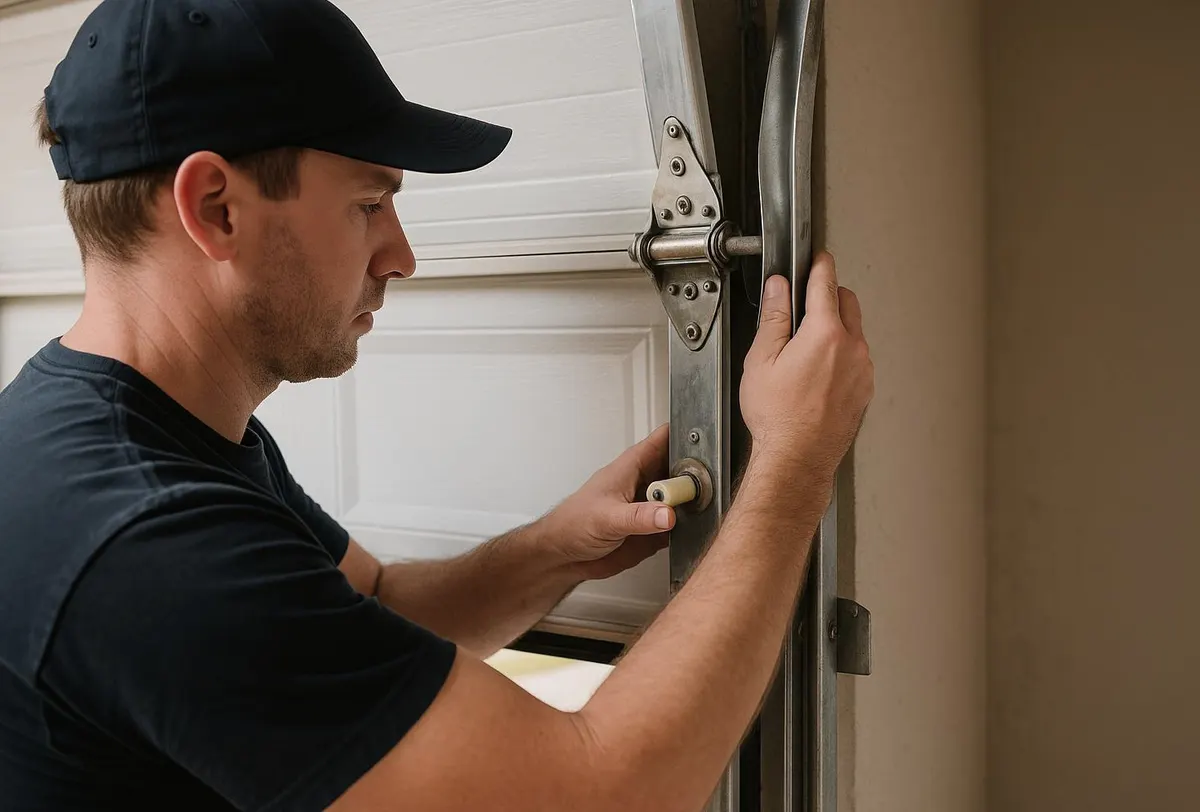
The first thing most homeowners do when the garage door starts rattling is grab a can of WD-40 and spray it on everything that moves. It's tempting because it's cheap, it's already in the garage, and the noise usually quiets down for a week or two. The problem is that WD-40 is a degreaser, not a lubricant. In Hilliard's humidity, it attracts dust and grit, gums up on rollers and hinges, and can actually speed up rust on the hardware that's already fighting salt air and moisture swings. The noise comes back worse, and now the parts are dirty on top of being loud.
A loud opener is almost always a combination of loose hardware, dry or wrong-lubricated moving parts, worn rollers, and an opener that's transmitting vibration straight into the house framing. Here's how to work through it in order, with the tools you need and where the line is between a weekend job and a call to a technician.
Step 1: Tighten Every Bolt on the Track and Hardware
Humidity and heat cause wood and framing to expand and contract through the year, and that movement works garage door hardware loose over time — brackets, hinges, and track bolts especially. A loose bracket rattling against the track is one of the most common sources of banging noise.
- Tools needed: socket wrench set, adjustable wrench
- What to do: Run the door up and down once to see which sections shake, then go bolt by bolt on the track brackets, hinges, and roller brackets. Snug everything down, but don't overtighten hinges — they need to pivot.
Homeowner job. This is safe to do with the door closed and the opener unplugged.
Step 2: Lubricate the Right Parts with the Right Product
Skip the WD-40 and use a silicone-based or lithium-based garage door lubricant, sold specifically for this purpose. It holds up better in heat and humidity without turning into a dust magnet.
- Tools needed: silicone or lithium garage door lubricant spray, clean rag
- What to do: Apply lubricant to the hinges, roller bearings (not the roller wheel itself if it's nylon), the top of the springs, and the chain or screw drive on the opener rail. Wipe off excess so it doesn't drip onto the floor or collect grit.
Homeowner job. Do this every few months, and again after any stretch of heavy rain or salt-laden coastal wind.
Step 3: Check the Rollers
Steel rollers are loud by nature, and they're more prone to rust in this climate. If your door has steel rollers and they're pitted, grinding, or visibly rusted, that's likely a big part of your noise.
- Tools needed: pliers, replacement nylon rollers (if swapping)
- What to do: Inspect each roller for flat spots, rust, or wobble. Rollers on the bottom brackets are generally safe to replace yourself. Rollers near the top sections, close to the high-tension spring area, are not.
Homeowner job for bottom rollers only. Upper rollers and anything near the spring system should go to a technician — that's also a good time to have us check for rust forming around spring coils, which is common near the coast.
Step 4: Check Chain or Belt Tension
A chain-drive opener with a loose chain will slap against the rail with every open and close. A quick visual check tells you a lot.
- Tools needed: none for inspection; adjustment usually involves a bolt on the opener's trolley assembly
- What to do: Watch the chain while the door runs. If it sags more than about a half inch off the rail, it likely needs tightening per the opener manufacturer's instructions.
Homeowner job if your opener manual shows a simple adjustment bolt. If you're not sure or the chain looks worn and stretched rather than just loose, that's a technician visit — over-tightening can strain the motor gear.
Step 5: Isolate the Opener from the Framing
Even a well-lubricated, well-adjusted opener can sound loud if it's bolted directly to framing that carries the vibration into living space above the garage. Rubber isolation pieces between the opener mounting bracket and the ceiling joist absorb a lot of that transmitted noise.
- Tools needed: rubber isolation kit (sold for this purpose), wrench
- What to do: Install isolators at the mounting points per the kit instructions.
Homeowner job if the opener is already properly supported. If the mounting bracket itself is sagging or the framing looks stressed, have a technician look at it before adding anything.
When a Belt-Drive Swap Is the Real Fix
If you've gone through every step above and the opener is still loud, the chain-drive mechanism itself may simply be the limiting factor. Chain drives are mechanically noisier by design. Swapping to a belt-drive opener replaces the metal chain with a reinforced rubber belt, which runs significantly quieter and holds up well in heat without the chain's natural clatter. This is a bigger job involving the opener motor unit, mounting, and sometimes rewiring safety sensors, so it's technician territory rather than a weekend project.
When to Call Precision Garage Door of Hilliard
If you've tightened hardware, re-lubricated properly, and the door is still loud, grinding, or shaking the wall when it runs, it's worth having it looked at before storm season puts extra strain on worn parts. Our technicians handle Garage Door Maintenance & Tune-Up visits that cover spring condition, roller wear, track alignment, and hardware checks in one trip, and if a belt-drive swap makes more sense than continuing to patch a tired chain opener, we handle Garage Door Opener Installation as well.
If your garage door opener in Hilliard, FL is driving you or your neighbors crazy, call Precision Garage Door of Hilliard. We'll track down the real cause and fix it right the first time.